Week 3
Digital Literacy on a virtual whiteboard
Teaching digital literacy means equipping students to critically evaluate digital tools and use them to their full potential (ACARA, 2022b). Australia’s rich open government data ecosystem provides an ideal foundation for this learning. Students can investigate resources like the ABS Digital Atlas of Australia, data.gov.au, National Archives of Australia, Australian War Memorial, or ACMI).
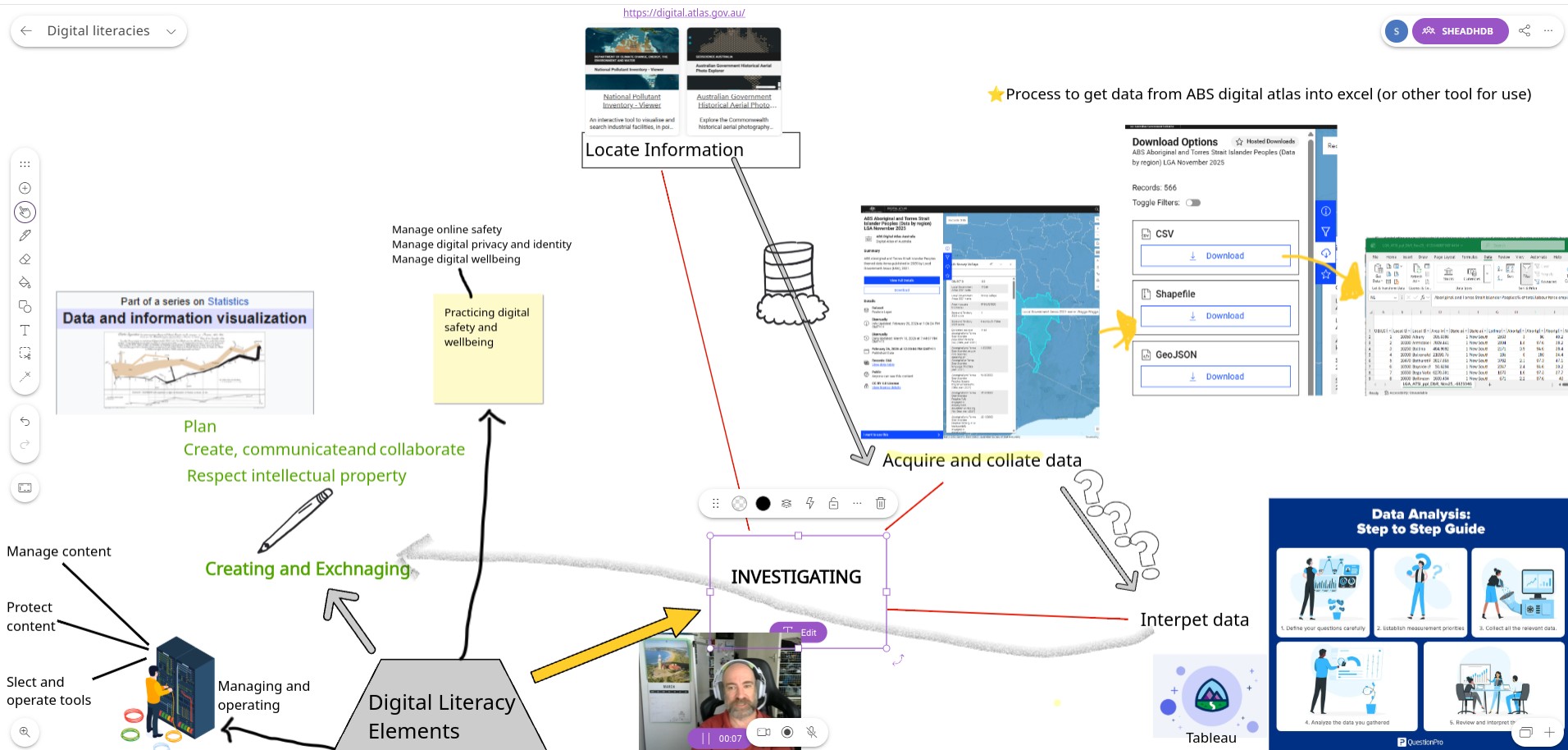
As shown in my Explain Everything diagram, the process of obtaining data is only the first step. Real learning begins when students critically interrogate where numbers come from (ACARA, 2022b): Why is data grouped by local government areas rather than postcodes? Do figures derive from surveys, censuses, or statistical modelling? This shifts the lesson into general capabilities—critical thinking, ethical understanding, and recognising that concepts like “family” differ across communities (ACARA, 2022a).
Interpreting data adds complexity. When students analyse and communicate findings, they engage in “creating and exchanging,” applying numeracy and productive literacy to transform data into shareable insights. Yet in an AI-driven world, this final step must go further: students need to analyse how tools operate, how they mislead, and how to create with them (Wyatt-Smith, 2024, p. 16).